Kelly Orgeron: Defying Limits on the Court in a Body Cast
Kelly Orgeron. She was a teenager in Arkansas wearing a full-body cast, and she still showed up to shoot baskets.
Not metaphorically. Not symbolically. Literally — in a cast, on a court, in a small town called Lake City where the population fit inside a grocery store parking lot. Her brother Scott watched and couldn’t understand it. “A lot of people would have said, ‘Poor me,'” he recalled years later. Kelly didn’t. She just kept shooting. That one image — a girl in plaster, dribbling — probably tells you more about Kelly Orgeron than any headline she’s appeared in since.
Because the headlines always arrive with someone else’s name attached. Coach O’s wife. LSU’s first lady. Ed Orgeron’s ex. Each label accurate, none of them sufficient.
Quick Bio
| Detail | Info |
|---|---|
| Full Name | Kelly Lynn Owens Orgeron |
| Born | December 30, 1964 (some sources report September 28, 1965 — see Honesty Note below) |
| Birthplace | Lake City, Arkansas |
| Nationality | American |
| Parents | Bobby Owens (father, deceased), Janis Owens (mother, d. December 25, 2012) |
| Siblings | Scott, Russ, Misty |
| First Marriage | Brian Spotts (ended before 1996) |
| Second Marriage | Ed Orgeron (married February 1997; divorce filed February 26, 2020) |
| Children | Tyler Spotts-Orgeron (from first marriage); twins Cody and Parker Orgeron (b. 1998) |
| Residence | Louisiana (Baton Rouge area, per 2018 reporting) |
| Known For | Former wife of LSU football coach Ed Orgeron; scoliosis survivor; 2025 Louisiana Supreme Court divorce ruling |
Where She Came From
Lake City, Arkansas sits in the northeast corner of the state, the kind of place where the main street doubles as the only street and everyone who leaves takes the town with them anyway. Kelly Owens grew up there as the third of four children — Scott, Russ, then Kelly, then Misty — born to Bobby and Janis Owens. Her father farmed. Her mother ran a beauty salon. Hard work wasn’t philosophy in that household; it was schedule.
From the day she was born, Kelly’s spine curved in the wrong direction. Scoliosis. She wore a brace, and then a full-body cast, and then at age fifteen, surgeons put a metal rod down her back. These weren’t minor interventions. They were the kind of medical experiences that change how a person thinks about time, about pain, about what counts as a normal Tuesday.
She played basketball anyway. She ran track. She eventually picked up a tennis racket, and at some point between doctor’s appointments and competition travel, she won USTA state championships in both Arkansas and Louisiana. Those weren’t participation trophies. Those were titles she earned with hardware welded to her spine.
Then her father died. Bobby Owens was in his forties when a train hit his car. Kelly was in college. That kind of grief doesn’t announce itself — it burrows in, quiet and patient, waiting. She didn’t know it then, but she’d carry the weight of that loss for nearly thirty years before she understood it was even there.
The Turning Point
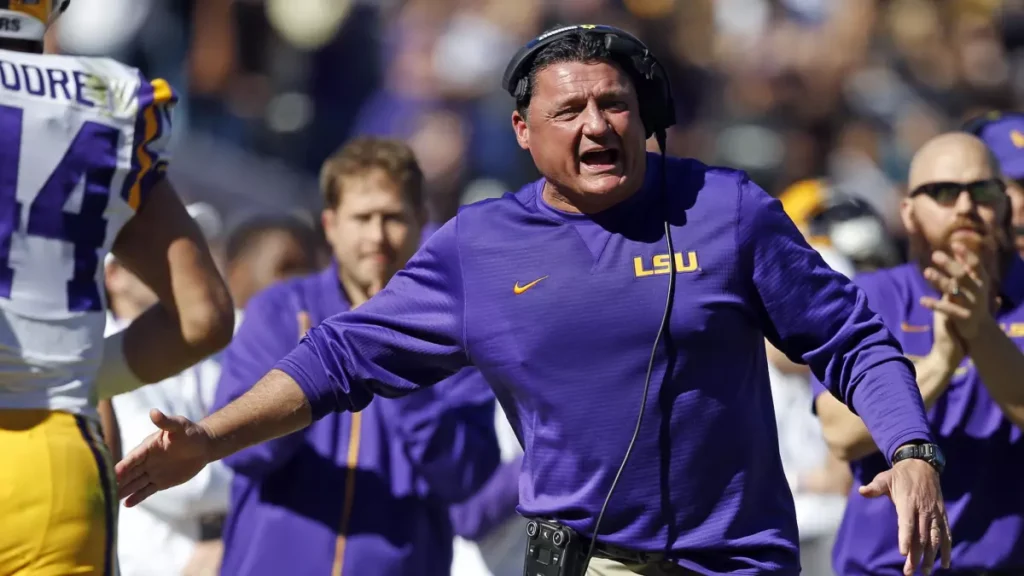
In December 1996, Syracuse’s football team lost a game that sent them to the Liberty Bowl in Memphis instead of the Orange Bowl in Miami. That loss, combined with a mutual friend’s insistence, is why Kelly Owens drove one hour from Lake City to meet a coach she’d never heard of, a man nicknamed “Bébé” who growled when he spoke and had more energy than sense.
She walked onto the bowl practice field and found him. “You must be Bébé,” she said.
Both of them were already divorced. Kelly had a three-year-old son named Tyler from her marriage to Brian Spotts. Ed had his own failed first marriage behind him. Neither of them was looking for complications. Two months later, they eloped in a Louisiana courthouse. “My family thought I was crazy,” Kelly later told The Advocate. “His, too.”
That courthouse wedding launched twenty-three years of motion — city after city, job after job, football season after football season. Syracuse. Ole Miss. USC. Tennessee. New Orleans. Baton Rouge. Kelly packed the house, enrolled the kids, unpacked, found the nearest church, and started over. Repeatedly. Most people get one hometown. She assembled a portfolio of them.
Life Inside College Football
The life of a coach’s family isn’t glamorous in the ways outsiders imagine. It’s driving a moving truck across state lines while your husband studies film. It’s raising twins during a season where the man you married is functionally unreachable from August through January. It’s showing up to stadiums in purple and gold and smiling for photographs while mentally doing the homework schedule for three boys.
Ed Orgeron missed the birth of Cody and Parker. He was coaching. Kelly handled it.
During Ed’s time on Lane Kiffin’s staff — first at Tennessee, then at USC — the family lived apart for five years. Kelly stayed put with the boys; Ed lived on the road. She held the household together across state lines with the calm efficiency of someone who’d learned long ago that falling apart wasn’t an option.
When Ole Miss fired Ed in 2007 after a 10-25 record, Kelly absorbed that humiliation alongside him. When USC passed him over for the permanent head coaching job in 2013 after he’d gone 6-2 as interim — reportedly one day after a board was discussing a $13 million contract, only for a loss to UCLA to change everything — Kelly absorbed that too. “This is not about the naysayers,” she told Sports Illustrated years later, “but, yes, it’s win or lose in this career. Do I listen to the naysayers? Do they really matter? Any time you feel the pressure and things get hard, that’s when you dig your heels in.”
She dug in. Over and over.
Meanwhile, she picked up her tennis racket. She won state championships while Ed scouted seventeen-year-old linemen. She decorated every house the family moved into with the same careful attention — the Baton Rouge home she redesigned from scratch in 2018 became what a Sports Illustrated reporter called “an elegant, white-themed portrait with a country girl’s stamp.” She shopped at T.J. Maxx. She made her prayer room before she made the living room.
The Crisis That Changed Everything

In May 2017, Kelly Orgeron went in for spinal surgery. Scoliosis had accumulated decades of damage, and surgeons needed to insert more rods and screws into her back and hips across two procedures that ran roughly ten hours each. It was serious, but it was also routine for Kelly — her fifteenth surgery, more or less. She was used to this.
What nobody expected was what happened four days later.
Ed woke at 4:30 a.m. to find Kelly’s stomach swollen to an alarming size. He called the doctor. Medical staff arrived to discover what the surgery had left behind undetected: a pin-sized laceration in her colon, a surgeon’s errant scalpel during the procedure. Her body was developing sepsis. They raced her to emergency surgery. A doctor pulled Ed aside on the way to the operating room and told him his wife might not make it.
Kelly heard him say it from the gurney. She was moving too fast to respond with words, so she raised her index finger and shook it at her husband — a gesture that meant, essentially: not yet.
She spent four hours in surgery. She woke up to learn doctors had performed a colostomy. For the next several weeks, she wore a collection bag attached to her abdomen. “I wish they would have never woken me up from this one,” she told Sports Illustrated, recalling that moment. At the same time, she said she heard Ed in the hallway shouting at someone: “Me and the boys can’t do this life without you.”
On July 27, 2017 — Ed Orgeron’s 56th birthday — Kelly underwent a successful reverse colostomy. Two months of hell had ended. She came home. She had fifteen surgical scars and three metal rods from neck to tailbone and two hooks and a dozen screws inside her body. She also had the perspective of someone who’d genuinely stared at the end and decided to keep going.
“Why was this my journey?” she asked a reporter months later. Then she answered herself: “I don’t know. But all these tests are part of my testimony.”
The Depression Nobody Knew About
The surgery story made national news. ESPN’s College GameDay ran a segment on it in November 2018, drawing tears from viewers who’d never considered what life looked like off the sideline. But there was another story inside the story that received less attention.
In 2012, Ed’s father and Kelly’s mother both died — two months apart. Kelly had spent years functioning at high capacity, raising three boys, moving cities, surviving surgeries, absorbing the pressures of public football life. She thought she was fine. Then she lost both of those people in rapid succession and stopped being able to eat. She dropped twenty-five pounds. Neighbors thought she had cancer.
She didn’t. She was depressed. Had been, she later concluded, for nearly thirty years — since her father died in that train accident when she was in college. She’d buried it. The grief had waited patiently underneath all that competence and all those moves and all those football seasons.
In 2013, Kelly spent ten days at Christian Healing Ministries in Jacksonville, Florida, a faith-based organization. “That’s what broke me,” she said of the back-to-back deaths. “I thought I was fine. I functioned, but you just put up that wall.”
She talked about it openly once she could. That, too, took a particular kind of courage.
The Divorce and What Came After
On February 26, 2020, Ed Orgeron filed for divorce in East Baton Rouge Parish Family Court. The couple had been married twenty-three years. The timing was noted immediately by legal observers: he filed forty-three days after signing a binding contract extension with LSU that came with a multimillion-dollar buyout clause — a clause triggered when LSU eventually fired him in 2021.
Two lower courts ruled against Kelly. The district court and the First Circuit Court of Appeal both sided with Ed, finding that the buyout was compensation for future work and thus wasn’t marital property.
Kelly’s attorneys appealed to the Louisiana Supreme Court and argued otherwise: the contract was signed during the marriage, its buyout protections existed during the marriage, and the raise itself was partly reward for the national championship run that Kelly had supported from her living room, her prayer room, and through every relocation across their two decades together.
On June 27, 2025, the Louisiana Supreme Court ruled 5-2 in Kelly’s favor. The court determined that the binding term sheet Ed signed January 14, 2020, constituted community property under Louisiana law. Kelly was awarded $8,134,500 — half of the buyout net of agent fees.
Ed sought a rehearing with support from twenty law firms. On September 4, 2025, the court denied it 4-3. The ruling stood.
“Kelly could not be more delighted,” her attorney Robert Lowe told reporters. “Justice was served.”
Controversies and Honest Assessments
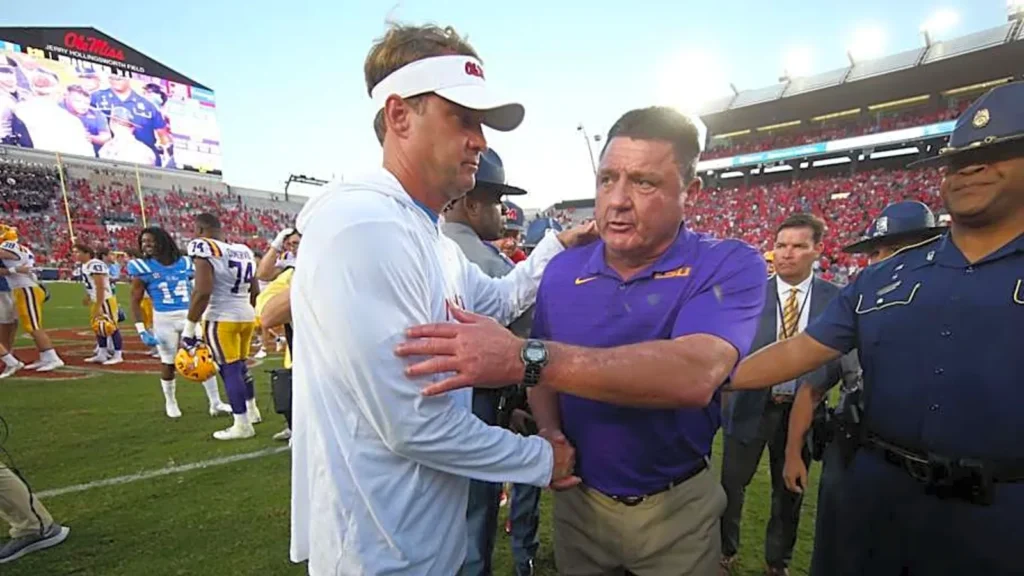
The divorce filing timeline: Ed filed for divorce forty-three days after signing the LSU contract extension. Whether that timing was strategic or coincidental is something neither party has addressed publicly, but the sequence of events is documented. The Louisiana Supreme Court ultimately determined it was irrelevant to the property law question, but it was widely noted.
The birth date discrepancy: Multiple biographical sources — some of which claim to be sourced from original documents — list Kelly’s birthday as either December 30, 1964 or September 28, 1965. No primary source has settled this. It’s a small detail, but it illustrates how frequently celebrity-adjacent biographical information circulates without verification.
Conflicting accounts of where Kelly grew up: Some sources place her birthplace in Louisiana; others correctly identify it as Lake City, Arkansas. The Sports Illustrated profile — the most rigorously reported piece on Kelly — identifies her as Arkansan, born and raised in Lake City, later moving to Louisiana. That’s the version this article treats as accurate.
Ed Orgeron’s post-divorce life: Ed announced his engagement to Bailie Lauderdale, a Hammond, Louisiana fashion model and entrepreneur, in May 2023. This doesn’t constitute controversy involving Kelly, but readers asking about the full picture deserve to know it.
Where She Is Now
As of 2025–2026, Kelly Orgeron is in her early sixties, living in Louisiana, and no longer a public figure by any institutional measure. She doesn’t coach. She doesn’t hold an official role in football. She has an active Twitter presence under @KellyOrgeron1, where she cheered for LSU games well after the divorce — posting “Good luck tonight to our LSU Football team” and “Forever in my heart — #LSU Football” through the 2021 season even after the divorce filing.
Her son Tyler Spotts-Orgeron, who added Ed’s surname to honor the family, works in college football coaching — most recently as an offensive analyst and tight ends coach at Tulane. Cody Orgeron played quarterback at McNeese State, throwing for 2,600 yards and 24 touchdowns in 2019 before graduating. Parker played wide receiver at McNeese State before concussions ended his playing career.
“They all want to be coaches,” Kelly joked once to Sports Illustrated. “I don’t know where I messed up.”
She got the house in Mandeville in the divorce settlement. She got $8.13 million from a Louisiana Supreme Court that decided her twenty-three years mattered. She still tweets her love for LSU football. She still hasn’t gone quietly.
Conclusion
Kelly Orgeron’s legacy isn’t written on a championship trophy or filed in a coaching record. It’s distributed across decades in subtler places — in a son who loved a stepfather enough to carry his name, in a blended family that actually worked, in a young woman in a body cast who decided that pain was not the same as stopping.
She didn’t craft a public brand. She didn’t write a memoir or go on speaking tours. What she left is more interesting than any of that: a five-decade medical record that would have broken most people, kept upright by stubbornness and something quieter that she calls faith. A marriage that ended but apparently didn’t turn to hatred — she was still cheering for his football team long after the papers were filed. A legal precedent in Louisiana community property law that will outlast both of their public profiles.
Her attorney said it clearly after the Supreme Court ruling: “Kelly Orgeron’s contribution to the couple’s success has been recognized.”
Coaches’ spouses move fifteen times and raise children and endure absence and hold households together across decades. What the court said on June 27, 2025, was that this counts. That it’s worth something. That it’s not invisible.
Kelly Owens of Lake City, Arkansas knew that already. She just had to wait for the law to catch up.
You may also like Hakeem Jeffries Wife
FAQ: What People Actually Search About Kelly Orgeron
1. Who is Kelly Orgeron?
She’s a former competitive tennis player, mother of three, and the ex-wife of former LSU head football coach Ed Orgeron. She gained wider public attention through a 2018 Sports Illustrated profile about her near-fatal surgical complications, and again in 2025 when the Louisiana Supreme Court awarded her $8.13 million from Ed Orgeron’s LSU buyout.
2. How did Kelly and Ed Orgeron meet?
On a blind date in Memphis in December 1996, arranged through a mutual friend, before the Liberty Bowl where Ed’s Syracuse team was playing. They eloped approximately two months later.
3. What happened to Kelly Orgeron medically?
She was born with scoliosis and spent much of her life managing it through surgeries, rods, screws, and a full-body cast as a teenager. In May 2017, surgeons accidentally nicked her colon during spinal surgery. The injury wasn’t discovered for four days, by which point she was developing sepsis and required emergency colostomy surgery. She spent twenty-one days in the hospital and underwent a successful reverse colostomy in July 2017. According to the Sports Illustrated profile, she has fifteen surgical scars and three metal rods in her spine.
4. When did Kelly and Ed Orgeron divorce?
Ed filed for divorce on February 26, 2020. Forty-three days before that, he had signed a binding contract extension with LSU that included a buyout clause. The divorce was finalized, and a legal battle over the buyout money followed.
5. How much did Kelly Orgeron get in the divorce?
The Louisiana Supreme Court ruled in June 2025 that she is entitled to $8,134,500 — half of Ed Orgeron’s LSU buyout net of agent fees. The ruling overturned two lower court decisions that had sided with Ed. His request for a rehearing was denied in September 2025.
6. How many children does Kelly Orgeron have?
Three. Tyler Spotts-Orgeron (from her first marriage to Brian Spotts), and twin sons Cody and Parker Orgeron (born 1998, with Ed Orgeron).
7. What did Kelly Orgeron do professionally?
She did not pursue a formal professional career separate from her family life during the marriage, though she was a competitive tennis player who won USTA state championships in Arkansas and Louisiana. Details about any professional activity since the divorce are not publicly confirmed.
8. Did Kelly Orgeron struggle with depression?
Yes, by her own account. She told Sports Illustrated that she believes she battled depression for nearly thirty years following the death of her father, though she didn’t recognize it as depression at the time. After the deaths of both her mother and father-in-law in 2012, she sought help at a faith-based healing organization in Jacksonville, Florida.
9. Where does Kelly Orgeron live now?
Based on the divorce settlement, she retained the family home in Mandeville, Louisiana. Her current specific address is not public.
10. Does Kelly Orgeron have social media?
Yes — she’s active on Twitter/X under @KellyOrgeron1, where she has posted publicly about LSU football and her sons through at least late 2021. Her Instagram handle has been listed as k_orgeron, though her activity there is minimal.
11. What is Kelly Orgeron’s net worth?
No verified figure exists. With the $8.13 million Supreme Court settlement plus whatever she received in other divorce assets, her financial position is substantially stronger than pre-divorce estimates suggested. Prior estimates of $600,000–$700,000 were from before the Supreme Court ruling and appear to reflect only assets at the time of initial divorce proceedings.
12. Who is Kelly Orgeron’s first husband?
Brian Spotts. They divorced before 1996. Their son, Tyler, later added “Orgeron” to his name to honor the family.
13. What happened to Cody and Parker Orgeron?
Both played football at McNeese State University. Cody was the starting quarterback and threw for 2,600 yards and 24 touchdowns in 2019. Parker played wide receiver before concussions ended his career. Tyler works as an offensive analyst and tight ends coach in college football.
14. Was Kelly Orgeron at LSU games after the divorce?
Her Twitter activity suggests she continued to follow and support LSU football well into the 2021 season, posting good luck messages and celebrations, indicating that the divorce did not turn her against the program or the team.
15. What is the significance of the 2025 Louisiana Supreme Court ruling?
Beyond the money, the ruling created legal precedent in Louisiana around community property law and coach contracts. It determined that a binding term sheet — signed during the marriage — constitutes marital property even if the full contract wasn’t approved by the university board until after divorce was filed. Several law firms supported Ed Orgeron’s appeal, and the 4-3 denial of rehearing suggests the legal question was genuinely contested. The ruling’s implications extend to other coaching families in Louisiana who face similar circumstances.